More than a century of cricket, community, characters and memories. Turn the pages to explore the story of Blackburn Cricket Club.
A Faltering Start
Blackburn Cricket Club was already in existence in 1888, although its exact origins may reach further back. The earliest known newspaper record describes a practice match in September 1889, with two Blackburn sides captained by Thomas Richards Burrowes Morton and Mr G. A. Goodwin. The wicket was described as matting over concrete, and the players later gathered at the Blackburn Recreation Hall.
In 1890–91 Blackburn was one of seven local clubs competing for the Reporter Trophy. The Club won its opening match at Doncaster by an innings, but finished runners-up to Box Hill after suffering its only defeat.
Blackburn then competed for the Eastern District Trophy from 1892 to 1898. The Club had emerged during the land boom of the 1880s, but went into recess in the late 1890s, probably reflecting the severe economic depression.
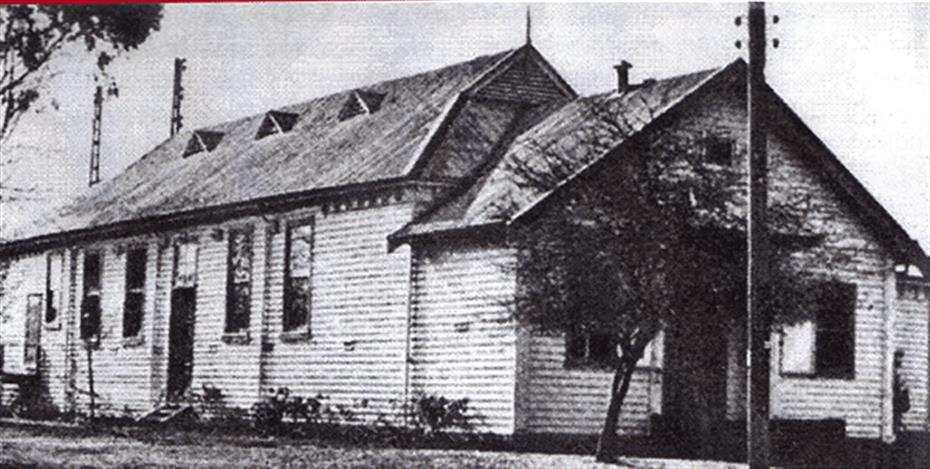
Historic Blackburn Town Hall — an early view of the township during the Club’s formative years.
A New Beginning
Blackburn Cricket Club was reformed in 1902 and played in the Eastern District competition in 1902–03. The following season Blackburn joined the Reporter competition and has not missed a season since — a record that remains unmatched in the Association.
In 1905 the local council acquired land and the existing hall at Morton Park to create recreation facilities for children and young people. Morton Park would become central to Blackburn's identity.
In 1908–09 Blackburn reached the A Grade final against Canterbury after winning nine matches and drawing one. Canterbury eventually prevailed after a final played over five Saturdays. When the competition was reorganised into graded divisions in 1910–11, Blackburn established itself in the top flight.
The First World War
The First World War arrived just before the 1914–15 season. Blackburn managed to field two teams for that season and the next, but official competition was then suspended for three seasons. The Club nevertheless fielded a side in friendly competition.
The war had a profound effect on the local community. Blackburn's surviving records cannot establish exactly which Club members served or were lost, but the Morton Park War Memorial records Blackburn residents who made the ultimate sacrifice.
The Club's history therefore sits within the broader history of the Blackburn community. The names remembered at Morton Park remain an important part of that story.
Remembering Those Who Served
One of the most important and sobering chapters in Blackburn's early history is the impact of the First World War on the local community. One twelfth of the population of the former Nunawading Shire enlisted for active service, and one in six of those who enlisted were killed.
The surviving records of Blackburn Cricket Club do not establish with certainty which Club members lost their lives during the Great War. However, the War Memorial at Morton Park records the Blackburn residents who made the ultimate sacrifice:
G. Cooper · C. N. Draeger · M. Farrelly · A. Geal · G. Geal · E. Gurdon · E. C. T. Hunter · A. J. Lawson · T. Mills · R. J. O'Hara · F. H. Pither · L. F. W. Rolfe · R. Scott · A. C. Sheehan · E. R. Smith · G. R. Stockfield · F. H. Stockfield · E. W. Welch · C. Youlden
Research later uncovered a newspaper article about Gunner Fred Hurst of Mont Albert, which noted his batting prowess when he had played for Blackburn Cricket Club a few years earlier. His former teammates wore black armbands in their next match as a mark of respect.
Finding Its Feet
After the First World War, Blackburn returned to regular competition and steadily rebuilt its strength. The Club reached finals in 1920–21, 1921–22 and 1923–24 before securing its first recorded premiership of the modern era in 1926–27, when the Second XI won the B Grade title.
The First XI followed with an A Grade premiership in 1932–33. Blackburn then reached the A Grade final again in 1934–35 and won the B Grade title in 1938–39. The Club also reached the 1939–40 A Grade final.
These years were about more than premierships. Blackburn was building a club culture that could survive changing times, and Morton Park was becoming an increasingly important home for local sport.
Reconstruction: Post World War 2
By August 1944 Blackburn was in a precarious position. Only six or seven members attended the Annual General Meeting, and Bert “Pop” Allen took the chair as the most senior member present.
The return of servicemen and recruitment of new players gradually restored numbers. Pop Allen was famously particular about presentation, and under his leadership the Club adopted its first official cap, maintained shared equipment and revived player awards and the Presentation Dance.
In 1950–51 Pop Allen led the Second XI to Blackburn's first post-war premiership. Players sometimes rode bicycles to away games and later travelled on the back of Len Toogood's truck after contributing sixpence each for petrol.
The establishment of an Under 16 team in 1952–53 became Pop Allen's most enduring legacy. The first season was winless, but the juniors won premierships in each of the following two seasons. Blackburn had begun rebuilding its future from the bottom up.
The Sixties: Halcyon Days
The Sixties were Blackburn Cricket Club's most successful decade to that point. The First XI won A Grade premierships in 1959–60, 1961–62, 1962–63 and 1964–65, while the Club's depth produced further senior and junior success.
The 1959–60 premiership ended a 27-year wait for the First XI. The 1961–62 season was extraordinary: Blackburn won the First, Third and Fourth XI premierships, while the Under 16s also won their Grand Final. The First XI recovered from a first-innings deficit against East Burwood and won by just four runs.
The First XI won again in 1962–63 and 1964–65. Junior success was equally impressive, with the Under 16s completing five consecutive premierships by the end of the decade.
The old Morton Park Hall was demolished to make way for a municipal library, increasing pressure to improve the pavilion as a social facility. By 1968–69 the Second XI had won back-to-back premierships and Tom Cullen had emerged as one of the Club's outstanding young players.
The Seventies
The Seventies began with the First and Second XIs both winning premierships in 1969–70. It was, however, the beginning of a much leaner period.
For the next nine seasons Blackburn won only one senior premiership. That came in 1973–74 when Brian Eddison led the Second XI to the A2 title. The First XI and other teams regularly reached finals but repeatedly fell short.
The 1976–77 season brought the First XI back into the McIntosh Shield finals for the first time in seven years. Blackburn defeated Doncaster in the semi-final before losing the Grand Final to Nunawading.
The decade ended with frustration but not surrender. Blackburn remained one of the Association's strongest clubs, and the lessons of the Seventies helped set up the resurgence that followed.
The Eighties
The Eighties opened with renewed optimism and a premiership after six years without a flag. Terry Sacristani arrived from East Burwood to coach the First XI.
The Third XI became the glamour side of the decade, winning four premierships. The Fourth XI also won two titles, while the Fifth XI captured the B Grade Seconds premiership in 1982–83.
Junior cricket improved dramatically. Under 16 premierships arrived in 1980–81 and 1985–86, Under 14s won three flags and Under 12s won three. A strong group of young players created greater depth for the senior teams.
The First XI twice reached the McIntosh Shield Grand Final, in 1986–87 and 1987–88, but finished runners-up on both occasions. The Shield remained the elusive prize. Off the field, the pavilion was progressively improved and the Cricket and Football Clubs began working toward better social facilities.
The Nineties
Blackburn entered the Nineties with strong depth. The 1990–91 and 1991–92 seasons produced a succession of junior and lower-grade premierships, while the Club continued building its pathway from junior cricket into senior teams.
The 1991–92 season was particularly productive, with premierships for the Fifth, Sixth and Seventh XIs and the Under 16s. The following season saw the Second XI and three junior teams reach finals.
The breakthrough came in 1993–94 when Blackburn's First XI finally won the McIntosh Shield. Further success followed, including a Second XI premiership in 1994–95, an Under 16 title in 1995–96 and another First XI McIntosh Shield in 1996–97.
The decade closed with another Second XI premiership in 1999–2000. Blackburn had re-established itself as a club capable of success across its senior and junior grades.
An Unbeaten Century
Blackburn entered the new millennium with a proud record: continuous participation in the Reporter competition since 1903–04 and a long history of senior and junior success.
The Club's first century of the modern era was documented in Neil Robertson's An Unbeaten Century – A History of the Blackburn Cricket Club 1902–2002. The work captured the premierships, statistics, characters, anecdotes and leadership that shaped Blackburn over its first hundred years.
The Centenary Committee also selected a Team of the Century, drawing on the knowledge of long-serving Life Members whose playing experience covered different eras from 1902 to 2002.
Blackburn CC Team of the Century 1902 – 2002

Blackburn Cricket Club Team of the Century, selected as part of the Club's Centenary celebrations.
Back Row: Robert Croft (12th man), Neil Robertson, Darren Croft, Craig Gislingham, Ivan Meehan, Russell Punton †
Front Row: Terry Dynes, Terry Sacristani, Tom Cullen (VC), Don Meehan (C) †, Neil Jacobs, Peter Grant.
Absent: Gary "Bags" Feenane (Scorer) †
The Selection Committee
In preparing for the Club's hundredth year in 2002, the Centenary Committee decided that it would be fitting to select a Team of the Century.
This decision was made with some trepidation given that aspects of any selection or omission may be controversial in some circles; however, the Committee felt on balance that such an undertaking had more positives than negatives.
Geoff Stephens framed criteria for both selecting the selectors and selecting the Team, which were endorsed by the Centenary Committee.
The selection committee comprised four members, who were all life members, 20 year players, and whose experience and knowledge of Blackburn 1st XI cricket covered as many years from 1902–2002 as possible. The men selected to perform this task, and the eras their experience covered, were:
Michael Long(1966–1992)
Andrew Smith(1977–2003)
Terry Dynes(1957–1986)
Neville Jacobs †(1943–1978)
The Early 2000s
The new century began with another major First XI success. In 2003–04 Blackburn won the McIntosh Shield and the Second XI also won its Shield 2 premiership.
Junior cricket remained central to the Club. Under 14 and Under 16 teams continued to appear in finals, while Blackburn remained firmly established in the Association's top flight.
The decade also saw the continued evolution of senior cricket, including one-day formats and broader opportunities for players across different levels.
Building Across the Club
The early 2010s produced sustained success across multiple grades. The Second XI won consecutive Shield 2 premierships in 2011–12 and 2012–13, while the Under 16s also enjoyed repeated success.
Junior cricket flourished further, with premierships across Under 12 and Under 14 grades, including multiple Blackburn teams competing in the same age group. Veterans cricket added another dimension to the Club.
In 2014–15 the First XI returned to the top of the Association, winning the McIntosh Shield. The season also produced premierships for the Fourth XI, Veterans, Under 14 and Under 12 teams.
New Formats and New Pathways
Blackburn continued to grow beyond the traditional senior structure. The 2015–16 season brought a T20 premiership alongside further junior success.
The 2016–17 season marked an important step in the development of girls cricket, with Blackburn winning the Under 13 Girls Anna Lanning Shield. T20 cricket continued to provide another pathway for senior players.
By 2018–19, girls cricket was producing premiership success and the Club was increasingly offering cricket opportunities to a broader section of the community. The 2019–20 season added further junior and girls participation.
The Early 2020s
The early 2020s brought disruption across community sport, but Blackburn continued to field teams and maintain its cricket pathways. The Club recorded T20, junior and lower-grade success across the period.
In 2020–21 Blackburn reached the T20 final and won an Under 16 premiership. The following season brought a Fifth XI premiership and further junior finals appearances.
The Club continued to develop cricket for girls and women alongside its traditional senior men's and junior programs, setting the scene for further growth.
A Broader Blackburn
The 2022–23 season was another broad-based success story. Blackburn won the T20 Mulgrave Country Club Shield and the Second XI Peter White Shield, while Girls Stage 2, Under 14 and Under 12 teams also won premierships.
The following season brought two Under 12 premierships, further junior finals appearances and the Women's First XI reaching the East C Grade Grand Final.
The emphasis was increasingly on building a sustainable pathway: introducing children to cricket, developing juniors, creating opportunities for girls and women, and ensuring players could progress into senior cricket.
Back to the Top
In 2024–25 Blackburn's First XI won the Ray McIntosh Shield, returning to the summit of the Association. The Third XI also won its A Grade premiership.
The season was a reminder of the Club's enduring strength: success at the top level was accompanied by continued participation and development throughout the senior and junior sections.
More than 120 years after Blackburn's first recorded matches, the Club remained competitive, community-focused and firmly connected to Morton Park.
The 2025–26 Season
The 2025–26 season added another chapter. Blackburn's First XI reached the Ray McIntosh Shield Grand Final, finishing runners-up, while the T20 side also reached its Grand Final.
Two Under 14 teams reached their respective Grand Finals, demonstrating the continuing strength of the junior pathway. Across the Club, cricket remained available to players at many levels and in multiple formats.
The results matter, but the deeper story is continuity: generations of players and families continue to arrive at Morton Park, play their cricket, make friends and contribute to the Club.
More Than Premierships
Blackburn Cricket Club's history cannot be measured only by its premiership tally. The Club has survived economic depression, two World Wars, changing competitions, changing social expectations and generations of players.
Its story has been carried by people: players who pulled on the cap, coaches who developed them, volunteers who prepared grounds and equipment, scorers and umpires, committee members, parents and supporters.
The junior program established in the early 1950s remains one of the clearest examples of how decisions made by one generation can shape the Club for decades. The same principle continues today.
One Club, One Community
From a practice match recorded in 1889 to the First XI of today, Blackburn Cricket Club has remained part of the Blackburn community for more than a century.
The old Blackburn Town Hall represents the world in which the Club's early members lived and played. The current First XI represents the Club as it stands today. Between those two images sits a remarkable story of cricket, community, resilience and generations of people giving their time to the Club.
The story does not end with this book. Every season adds another page. Every player, coach, volunteer, parent and supporter becomes part of what Blackburn will leave to the next generation.
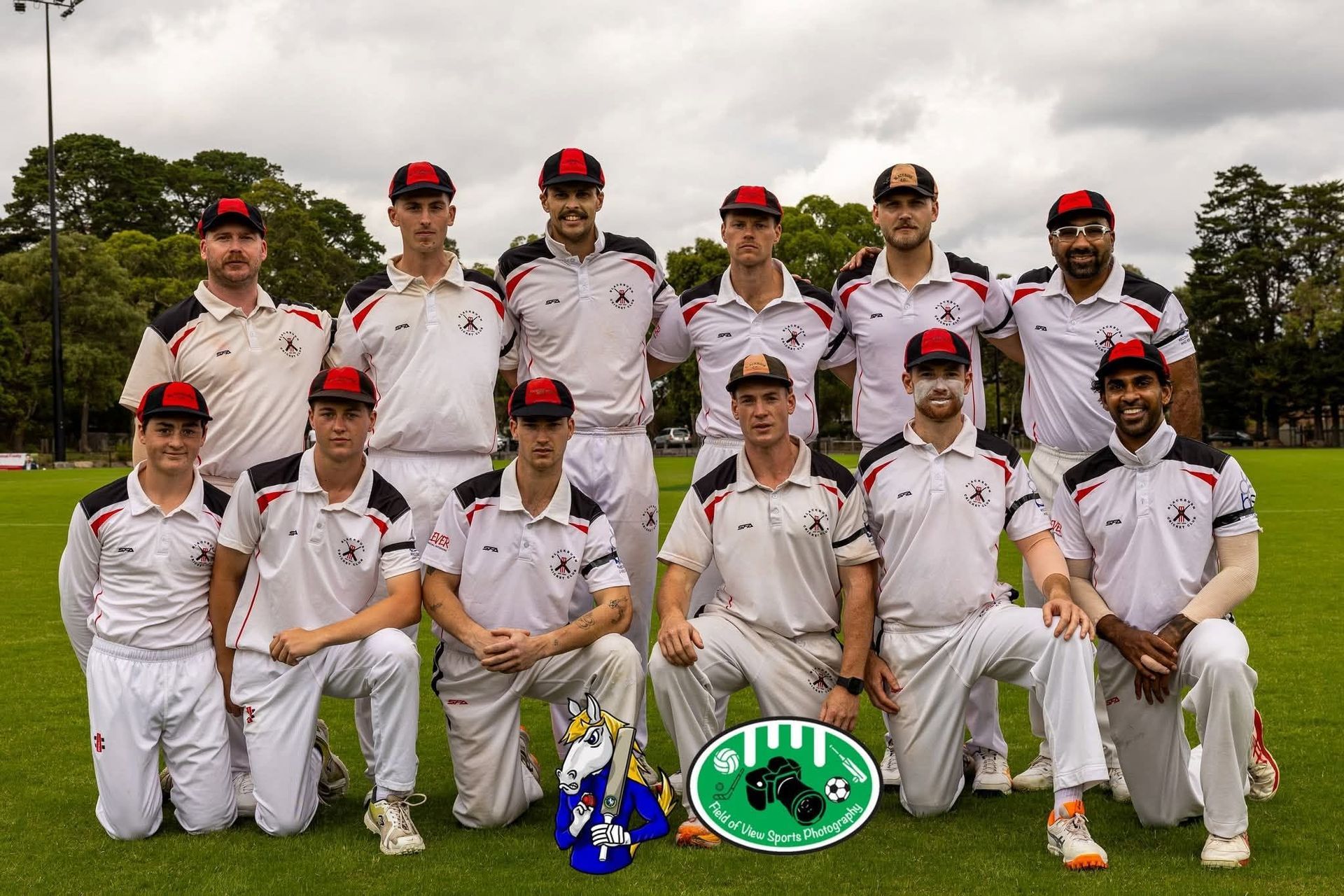
Blackburn Cricket Club First XI — 2025–26.
3130 Forever.